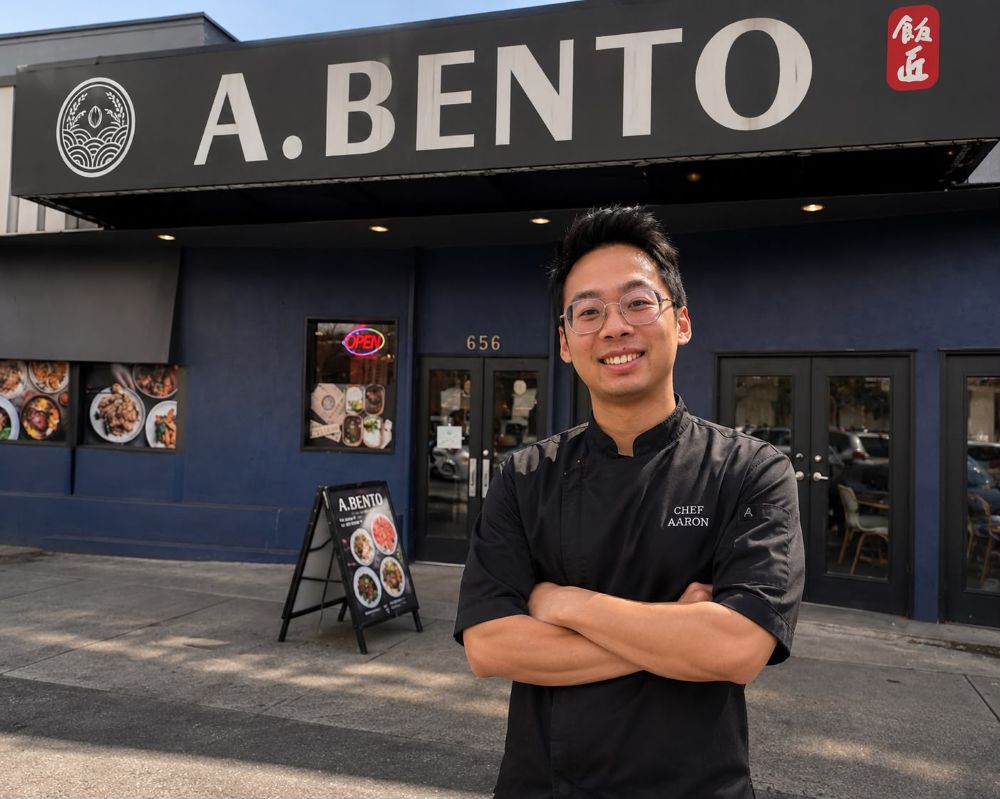
At A.Bento, Chef and Owner Jian (Aaron) Zhou presents his modern interpretation of traditional Taiwanese cuisine. Zhou’s culinary curiosity started at a young age, and he soon began teaching himself to cook through online videos. To further cultivate this curiosity, Zhou began working in kitchens as well as pursuing a formal education. While in culinary school, Zhou recognized a void in Vancouver’s restaurant scene: Taiwanese food. Now, the menu at his restaurant A.Bento reimagines classic Taiwanese bento for a modern audience as he blends traditional flavours with high-quality, locally sourced ingredients. We spoke with Zhou to learn more about how Vancouver’s food culture has influenced him, his favourite local ingredient, and the future of A.Bento.
What first inspired you to become a chef, and how has your journey led you to Vancouver?
Growing up, my mother was always cooking in the kitchen while my father was busy managing his company and factory. However, no matter how busy he was, whenever he came home, he would always help my mother in the kitchen. He also taught my sister and me that we should always help our mother whenever we could.
Because of that, my first inspiration to become a chef was very simple—I just wanted to help my mom in the kitchen. Over time, what started as helping with meals grew into a genuine passion for cooking. I discovered how much I enjoyed preparing food and seeing the happiness it brought to family and friends.
When I turned 17, my parents decided to send my sister and me abroad to study so that we could experience different cultures, environments, and ways of life. Living overseas opened my eyes to many different cuisines and culinary traditions, which deepened my interest in food and inspired me to pursue cooking professionally.
Who were some of your biggest influences, either chefs or family, in shaping your approach to cooking?
My biggest influence has always been my father. As a businessman, he spent a lot of time meeting people and dining out for work. Whenever he tasted something special or memorable, he was always curious about how it was made. He would ask questions, research recipes, and try to recreate the dish at home whenever he had the time.
Watching him taught me that cooking is not just about following recipes—it is about curiosity, creativity, and a willingness to keep learning. He inspired me to explore new flavours and techniques and to never stop improving.
What’s the story behind your restaurant — how did it come to life?
The idea behind my restaurant came from my experience studying in high school here. At the time, I noticed that the cafeteria options were quite limited, and most of the food was sandwiches or very simple meals. It made me think about how nice it would be to have more variety and more balanced options for students.
That’s when I started to imagine bringing Taiwanese-style bento to a school or everyday lunch setting. I wanted to offer something that is both convenient and nutritious, with a good balance of fresh vegetables, proteins, and comforting flavours. For me, it wasn’t just about food—it was about creating a healthier and more enjoyable lunch experience.
That early idea eventually grew into something bigger and became the foundation for my restaurant, where I focus on bringing thoughtful, balanced meals inspired by Taiwanese home-style cooking.
How does the food culture of Vancouver influence your cooking style or menu choices?
Vancouver’s food culture has had a big influence on my cooking style and the way I design my menu. One of the most unique things about Vancouver is its diversity. People from many different countries live here, which means you can find an incredible variety of authentic and high-quality foods across the city.
Because of this mix of cultures and backgrounds, I’ve learned that cooking here is not just about following traditional methods exactly. Sometimes it’s important to adjust ingredients or cooking techniques to better suit local tastes while still respecting the original style of the dish. This balance between authenticity and adaptation is something I think about a lot when developing my menu.
What’s one local ingredient you can’t live without in your kitchen?
One local ingredient I can’t live without in my kitchen is Dungeness crab. It is very fresh and high quality in Vancouver, and it has a naturally sweet and rich flavour that works well in many dishes.
We use it as a key ingredient in our crab sauce, where its natural sweetness and depth really stand out. It adds a luxurious and comforting taste that represents the quality of local seafood here in British Columbia.
If someone was visiting Vancouver for the first time, what food experience would you insist they try?
I would definitely recommend they try a local seafood-focused dining experience, especially dishes that highlight fresh West Coast ingredients like Dungeness crab, spot prawns, or Pacific salmon.
What makes Vancouver special is the quality and freshness of its seafood, combined with the city’s multicultural food scene. You can experience very traditional preparations, but also creative fusion dishes that reflect the diversity of the people here.
What restaurants, cafés, or hidden gems in Vancouver do you personally love to eat at when you’re off-duty?
For something more casual and comforting, I like going to places such as Phnom Penh for their signature Vietnamese and Cambodian dishes. For sushi, I really appreciate the quality and attention to detail at Tetsu Sushi Bar.
When I’m in the mood for something more refined or traditional Indian cuisine, Vij’s is always inspiring, and Tojo’s Restaurant is another place I respect a lot for its influence on Vancouver’s Japanese dining scene.
How do you think the dining scene in Vancouver is different from other Canadian cities?
I think the dining scene in Vancouver is quite different from many other Canadian cities because of its unique cultural diversity and access to high-quality local ingredients.
Vancouver has a very strong Asian influence compared to many other cities, especially with Chinese, Japanese, Korean, and Southeast Asian cuisines being deeply rooted in the food culture. At the same time, you also see a strong focus on fresh, local, and seasonal ingredients because of the West Coast environment. That combination creates a very interesting balance between authenticity and innovation.
Where do you like to shop for ingredients locally — farmers’ markets, specialty shops, or a particular supplier?
For fresh and seasonal produce, I like visiting local farmers’ markets such as the Vancouver Farmers Market. It’s a great place to find high-quality vegetables, fruits, and sometimes unique seasonal ingredients directly from local growers.
Beyond food, what makes Vancouver special to you as a place to live and work?
I really appreciate how close everything is to nature. In a short drive, you can go from the city to the mountains or the ocean, and that environment brings a sense of calm and inspiration. It helps me reset and stay creative in my work.
I also value the diversity of people here. Vancouver is a place where many cultures come together, and that creates a very open and respectful community. As someone working in food, I find it very inspiring to be in an environment where different cultures and stories are naturally shared through everyday life.
What’s next for you and the restaurant?
For our manufacturing side, we are currently working on obtaining more certifications so we can expand our production capabilities and eventually launch more of our products into local stores. Our goal is to make our products more accessible to customers across Vancouver while maintaining high quality and consistency.
For the restaurant, we are focused on keeping our current standards strong and consistent, making sure every dish reflects our original vision. At the same time, we are also open to future opportunities, including the possibility of opening a second location when the timing and conditions are right.