Raised in rural Southern Ontario, Chef Corbin Mathany took an unconventional path to opening Victoria’s acclaimed Ugly Duckling Dining & Provisions. After first venturing into restaurant kitchens while studying at Brock University, Mathany built his career through a series of unlikely detours, hard lessons, and lucky breaks. Today, Ugly Duckling reflects that journey: deeply personal, quietly playful, and driven by the belief that the best experiences rarely follow a straight line. We spoke with Mathany about the winding road to Ugly Duckling, the experiences that shaped his cooking, and what continues to inspire his approach to hospitality.
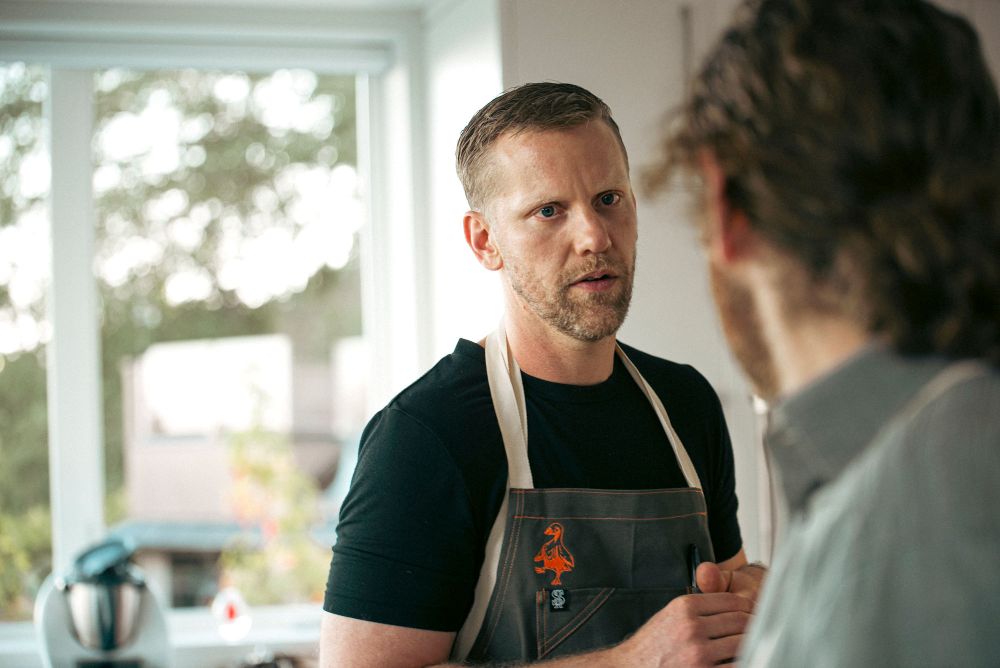
What first inspired you to become a chef, and how has your journey led you to Victoria?
I came to cooking a bit later than most — I hadn’t set foot in a professional kitchen until my mid-20’s, but looking back, it feels almost inevitable that this would be where I found myself.
My earliest and best childhood memories all centre around food; whether holiday dinners with my family, or the over-the-top barbecues that my dad would throw in the summer. They were my favourite moments. I’d spend all of September looking forward to apple season, when my grandmother would bake endless pies with apples from the abandoned orchard across the road. And in the spring, I’d anxiously await the strawberry-rhubarb edition.
Weeks before asparagus started popping up, we’d be scouring the creek that ran through that same orchard, looking for the first signs of life. When it finally arrived, we’d forage for it and cook it for practically every meal. Always the same: grilled hard and topped with heaps of parm and lemon juice.
I was living with the rhythms of the seasons and (more importantly) learning the power of food to connect people long before it occurred to me that any of this could become a career, but when it finally did the path was painfully obvious.
Who were some of your biggest influences, either chefs or family, in shaping your approach to cooking?
That same grandmother — she of the apple pies and asparagus picking — was the single biggest influence on my trajectory.
There was a long time when she’d have preferred that I’d taken another path — she didn’t see cooking as an honourable or stable profession and probably didn’t see the power of her own cooking to nurture, to spark joy, and to bring people together. Despite her best efforts though, she’d already taught me everything I’d ever need to know about the magic and beauty of cooking.
She’s very much still alive — 94 and no longer scrambling into creek-beds for asparagus or churning out pies at her former pace. I’d like to think that she’s come around on my career choice.
What’s the story behind your restaurant — how did it come to life?
Opening a restaurant that would enable me to provide exactly the sort of experience I’d long envisioned was always the end goal, from my first clumsy day in the kitchen.
Moving to Vancouver Island brought me back to the same intensely seasonal and place-based experiences that formed my culinary identity; but with a vastly broadened palate of ingredients and an inspiring landscape to go with it. From the moment I arrived on Vancouver Island in 2012, the identity of the restaurant began to coalesce around what I’d found here.
The restaurant itself was a pandemic baby. When I found myself with no job and very little to do in the spring of 2020, I spent a few days taking long walks with my partner and drinking gin & tonics too early in the day before I decided to make lemons from the lemonade, so-to-speak. I got serious about planning, started to send out feelers to potential investors, and finally did the work to understand what it would take to build Ugly Duckling.
How does the food culture of Victoria influence your cooking style or menu choices?
We seek to reflect the place where we live — both in the context of coastal BC, and in paying homage to our Chinatown location. The culture here (both food and otherwise) is ever-present in our minds. This is evident from the art on the walls to the ingredients in the kitchen, to everything that the guest touches, sees, or tastes.
Victoria is also a determinedly casual town, so we try to offer an experience that’s elevated and intentional; but wrapped in an approachable and unpretentious package.
What’s one local ingredient you can’t live without in your kitchen?
The answer to this question depends entirely on the season in which it’s being asked, but I guess Vancouver Island Sea Salt transcends seasonality, so we’ll go with that.
If someone was visiting Victoria for the first time, what food experience would you insist they try?
I think that going on a foraging expedition (and there are guided ones available) is the best way to feel the connection between our landscape and the plate. In the fall, I forage for chanterelles just about every weekend. I wish that I could take every restaurant guest out foraging before they eat those mushrooms.
What restaurants, cafés, or hidden gems in Victoria do you personally love to eat at when you’re off-duty?
Off duty usually means late-night, and pickings in Victoria are notoriously slim during those hours. Cera is my favourite after-work haunt for a post-shift beverage and some real (and very good) food. An enthusiastic nod goes to Wind Cries Mary for scratching the same itch.
I also love Rabbit Rabbit, and would go to Lumache weekly if I could get in. For all of the great coffee options Victoria has to offer, the area where I live is a bit of a coffee desert. I’ve had to get an espresso machine for home and learn how to pull a decent shot to get by.
How do you think the dining scene in Victoria is different from other Canadian cities?
Being on an island, I think we’ve remained a bit of a culinary backwater until recently. The scene is decidedly casual, and there have been times in the past where I almost felt as if I was expected to apologize for doing something ambitious. A decade ago, a tasting menu-only restaurant in Victoria would have been unthinkable.
But I do believe that there’s a hunger for more elevated dining here, and a glut of new entrants are providing meals that are more refined and more varied than ever before. If I can make a prediction, I think that Victoria (and Vancouver Island, more broadly) is primed to emerge as a travel-worthy dining destination over the next few years.
Where do you like to shop for ingredients locally — farmers’ markets, specialty shops, or a particular supplier?
I like to deal directly with farmers wherever possible, but The Root Cellar does a lot of heavy lifting for us on that front. They amalgamate produce from a whole bunch of local farms and save us the trouble of ordering one or two things from each of a dozen different farms — there are times when a middleman is a blessing. During the summer, Moss Street Market is a can’t-miss, and it’s how we’ve met a lot of the farmers that we have relationships with.
Beyond food, what makes Victoria special to you as a place to live and work?
There truly is no place like it. Victoria is small enough to feel familiar, yet enough that it feels energetic if you look in the right places. It’s almost impossible to describe, but the city really does live up to its ‘island vibe’ reputation. I’ve lived in a lot of places across Canada, but none has felt more immediately and completely like home than Victoria.
What’s next for you and your restaurant here?
All I want to do is keep learning and growing as a chef & restaurateur. We’ll stay hungry, keep striving to raise our own bar, and see where that takes us.