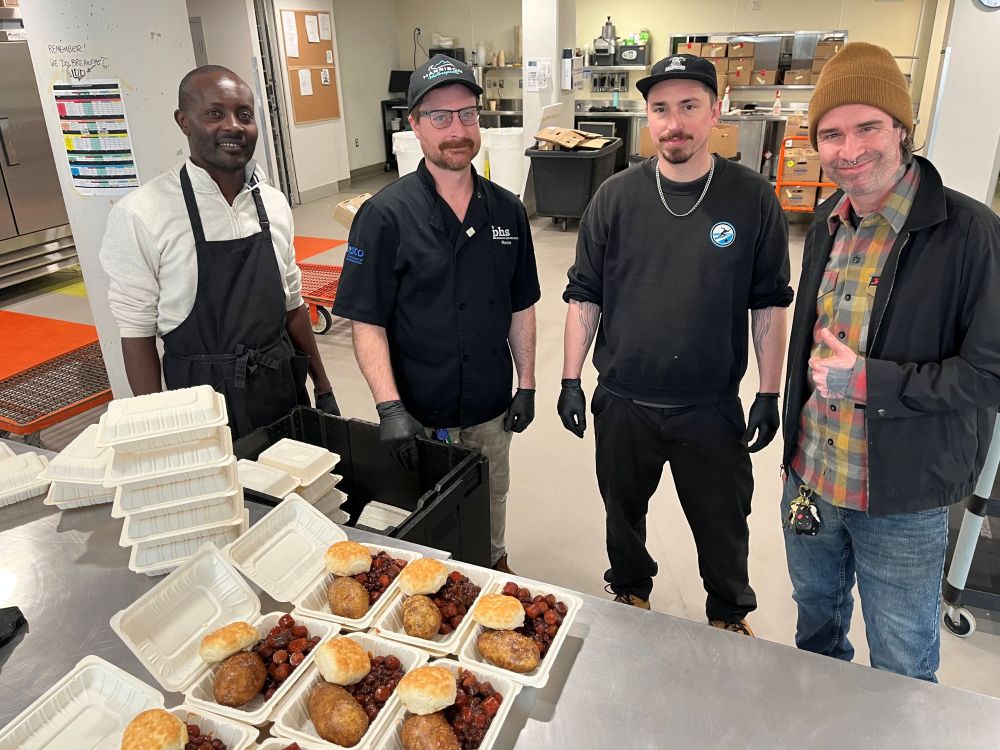
Every day, PHS Community Services Society prepares more than 2,300 meals for residents and program participants across Vancouver and Victoria. The organization’s food program ensures people in supportive housing have access to nutritious, reliable meals. We spoke with Senior Manager of Procurement Andrew Adam about the program and the growing demand behind it.
Describe your charity/non-profit/volunteer work in a few sentences.
PHS—founded in 1993 and formerly known as the Portland Hotel Society—is one of BC’s largest supportive housing operators, serving thousands of people daily who struggle with complex health needs in Vancouver and Victoria by providing supportive housing, healthcare and harm reductions programs.
What problem does it aim to solve?
PHS’s Food program was created to provide meals to marginalized people who are generally living without functional kitchens and have pressing nutritional needs.
The most pressing problem we’re trying to solve is that our Food Program in Vancouver has completely outgrown the two kitchens we started many years ago. The Program is producing over 1,800 meals a day out of spaces that were originally built for less than 200, so we are operating well over capacity and constantly breaching the limits of what the infrastructure can handle. PHS continues to take on more supportive housing sites, and the number of people who rely on us for meals keeps growing. We will need to scale to 3,000 or even 4,000 meals a day, but we simply cannot meet that need safely or reliably in our current setup.
While the two small kitchens our Food Program currently operates from are inadequate, our team has still managed to consistently deliver a wide variety of nutritious, culturally relevant meals. We’re incredibly proud of that, but to keep serving our community the way they deserve, we need a space that can actually rise to the demand.
That’s why we’re working so hard to move into a proper commissary kitchen—somewhere safer, more resilient, and designed for the volume and variety we’re producing.
When did you start/join it?
I joined PHS a little over two years ago, after spending several years working in Northern BC as the Camp Services Manager for a very large mining company. Working with PHS has been incredibly rewarding and illuminating— serving disadvantaged communities, adapting to tight food budgets, and finding ways to make high‑volume meal production run smoothly in challenging environments makes it feel, some days, like we’re pulling off small miracles with the resources we have, and I’m really proud of what our team is able to accomplish.
What made you want to get involved?
The reason I got involved with PHS was the impact I saw the organization having on communities that really need support. Feeding thousands of miners every day for many years was rewarding in its own way, but I wanted to do something that felt more connected and meaningful.
When I learned about PHS and the work happening in Vancouver and Victoria, I genuinely felt like this is a place where my skills could make a real difference.
So for me, it was the combination of purpose, challenge, dignity, and community. I wanted to be part of something that mattered, and PHS is exactly that.
What was the situation like when you started?
When I first started at PHS a little over two years ago, the situation was already pretty intense. It was both exhilarating and daunting to be pushing 1200 meals a day out of kitchens designed to produce 200. Even then, demand was growing, clearly outstripping what our space or equipment could keep up with.
And I was frankly amazed at what and how this team was producing on funding of $7 per person per day – breakfast, fresh fruit, and a hot nutritious meal – all done with a ton of creativity and heart despite the limitations.
How has it changed since?
Since joining PHS’s Food Program, the biggest shift has been the sheer scale we’ve grown to. What once felt demanding has accelerated into a much larger and more complex operation, and it’s become increasingly clear how essential it is to have systems and space that can keep up. Alongside that growth, moments of disruption have underscored how quickly we need to adapt and how important stability is for the people who rely on us.
What stands out most, though, is how the team has met that growth with unwavering commitment. Even as demands have increased, they’ve continued to show creativity, resilience, and a deep sense of responsibility to the communities we serve. The scale may have changed, but the heart of the work — and the dedication behind it — has only strengthened.
What more needs to be done?
What really needs to happen next is securing a proper, street‑level commercial kitchen that’s designed for the scale we’re operating at and can expand into. At this point, it’s the key step that will let us keep the program stable and growing in a sustainable way. A purpose‑built space where we can design the workflow from the ground up will give us what our current setup just can’t. Having larger cold storage areas will allow us to build up real multi-level reserves—and with the right-sized equipment, we’ll be able to work efficiently and increase our meal production scale.
Having a centralized, dedicated facility also means we can plan better, buy smarter, and respond faster when things change. It lowers our costs over time and gives us the kind of reliability the community depends on. All of that makes this new kitchen not just a nice‑to‑have, but something that will set us up for the long term and help us continue being a steady part of the food‑security network in Vancouver.
How can our readers help?
The biggest way people can help right now is by spreading the word about what we’re trying to do. We’re at a point where securing a proper commercial kitchen isn’t just a nice upgrade—it’s something that will reshape the future of our whole food program and the thousands of meals we put out every week.
If you’re connected to people who care about food security, housing, or community health, let them know what’s happening. The more awareness we can build, the easier it becomes to rally the support we need—whether that’s through partnerships, donations, or simply opening doors to conversations we haven’t had yet.
Even just following PHS and staying engaged with our work makes a difference. It helps keep the momentum going, and it reminds our team—and the people we serve—that the community is behind them.
And if anyone wants to reach out to help us or learn more about this project, please email donations@phs.ca.
Do you have any events coming up?
For sure! The Under Armour Eastside 10K. PHS participates and benefits from donations make to our PHS run team in the Under Armour Eastside 10K on Sunday, September 27th, 2026. We’re looking for individuals and businesses to join our PHS run team and help us with fundraising. Our goal is to raise $30,000 for our supportive housing and harm reduction programs that are accessed daily by thousands of vulnerable people. Please join or donate to our PHS run team here.
Where can we follow you?
You can follow PHS on our social media channels and website:
Facebook | Instagram | LinkedIn | BlueSky | PHS Website
PAY IT FORWARD: What is an awesome local charity that you love?
We got a lot of love to go around, but for this shout-out, we name the ever-awesome Eastside Arts Society, home of the Eastside Culture Crawl.