
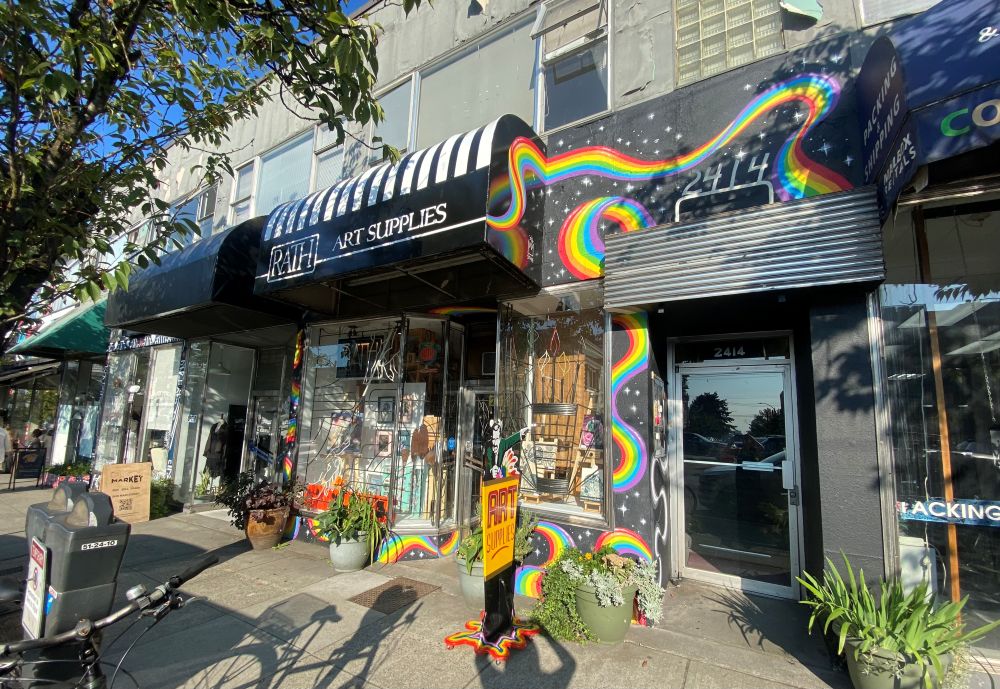
When Theresa Frazao bought Rath Art Supplies from longtime owner Stan in 2018, she did so in order to preserve the charming, ramshackle art store. Rath felt to her like an important window to a disappearing past. Now, almost ten years later, Frazao sees Rath as playing a powerful role in the re-centring of human-made, analog art. Her customers range from a close community of local artists to creators across Canada who order online. While she has brought a little more order to the shop, which was once packed floor to ceiling — and she’s also stopped giving paper receipts — she has succeeded in preserving the soul of Rath. It continues to serve and support artists of all skill levels. And, the team of dedicated staff (including Picco the resident dog) are ready to help with genuine curiosity and expert knowledge. We spoke with Frazao to learn more.
What is your business called and what does it do?
Rath Art Supplies is a one-of-a-kind, artist-run fine art supply store in Vancouver, BC. We specialize in professional-grade materials, high-quality beginner supplies, and hard-to-find art products you can’t find anywhere else in the city. We also build custom canvases and wood panels, including oversized and non-standard formats, made in-house with our local woodworker.
What made you want to do this work?
I’m an artist myself, and before owning Rath I worked in the non-profit/charity sector for over 25 years, integrating arts programming whenever I could.
When I learned that the store’s founder, Stanley Rathbun, who ran the shop for 30 years, was planning to retire, I became obsessed with running the store and preserving what Rath stood for — deep knowledge, great materials, and artist-focused service. When Stan ran the shop, he was also the woodworker, and it’s impossible to do everything. His passion was building custom surfaces for local artists, and the shop was loved but famously a bit disorganized. Many customers still remember the days of handwritten receipts — very charming, until you’re writing page after page for someone restocking their studio and trying to do inventory by hand afterward.
Today, Rath runs as a small but thoughtful team. I knew I didn’t want to be a woodworker myself, so I hired an excellent one, and I focused on strengthening the retail side of the business — building systems that support our staff, our customers, and the long-term sustainability of the shop. We now have barcode scanners, synced inventory, and workflows that make things far easier for everyone behind the counter.
It’s been a huge challenge, but also incredibly rewarding. Along the way, I’m learning so much more about art materials myself — and having a lot of fun experimenting in my own studio time.
What problem did you want to solve with the business?
I wanted to protect and strengthen a space where artists feel comfortable asking questions and actually getting thoughtful, honest answers. Our team takes the time to help as much as we can based on experience and shared knowledge, and when we don’t know something, we’ll help find the answer. We hear all the time from customers that in other stores it’s hard to find someone who has the time — or the curiosity — to really help.
Many of our regulars have built genuine relationships with our staff. We recognize people the moment they walk in the door, and that kind of care is difficult to find in big-box or chain stores. That sense of familiarity and trust is something we value deeply, and our customers feel it.
It’s also surprising to me how few art supply stores there are in Vancouver, given how large and creative the city is. Rath is truly unique — cozy, warm, more than a little old-fashioned, and packed floor to ceiling with treasures. Between our knowledgeable staff, expertly skilled in-house woodworker, and Picco — our resident shop dog who takes his greeting duties very seriously — the space feels genuinely warm and welcoming. At the heart of it, the problem I wanted to solve was how to keep a place like this alive: a store that offers expert advice, high-quality materials, and custom solutions, while protecting the spirit of a space that supports serious creative work at every stage.
Who are your clientele/demographics?
Our customers range widely — professional artists, art students, educators, hobbyists, and people exploring art for the first time. We serve everyone from internationally recognized artists to beginners who want guidance and encouragement. What connects them all is a shared curiosity and a desire for personal expression through materials.
Lately, I’ve noticed a strong return to basic drawing and traditional skills. After years of growth in digital art — and now with the rapid emergence of AI-generated imagery — there seems to be a real pushback within the arts community. Many people are craving hands-on, tactile processes and time away from screens. I wouldn’t be surprised if art buyers worldwide increasingly seek out work that shows the human touch: visible mistakes, texture, scribbles, and evidence of the hand. Art that isn’t smooth or perfect, but unmistakably made by a person.
How does your business make money? How does it work?
We generate revenue through the retail sale of fine art materials, custom-built canvases and wood panels, and specialty services like stretching artwork. The shop operates with a small team — combining knowledgeable retail staff and in-house woodworking — which allows us to offer both materials and custom solutions under one roof.
We’re a small, independent brick-and-mortar shop with a strong local customer base, supported by an online store. While the shop is very community-focused, we also ship many items to customers across Canada. Our emphasis is on quality, expertise, and long-term relationships rather than high volume or fast turnover.
Where in the city can we find your profession?
You’ll find us in Mount Pleasant on Vancouver’s Triangle Block, an area with a long history of artists, studios, and creative businesses. Rath has been part of this neighbourhood for over 20 years, and continues to be a place where artists come not just to shop, but to talk, ask questions, and feel at home.
What is the best question a prospective customer could ask a member of your profession when comparing services? Give the answer as well.
A great question to ask is, “Can you help me choose the right materials for what I’m actually trying to make?”
A good art supply store isn’t just about selling products — it’s about understanding how materials behave and guiding artists toward tools that support their ideas rather than fight them. That kind of help takes time and experience, and it’s something our staff genuinely enjoy doing.
We don’t try to upsell people. We stand by our student-grade materials and will always work within a customer’s budget. If someone does want to explore professional-grade options, we’re happy to guide them — but only if it truly serves the work they want to make. What matters most is that people leave feeling confident and excited about what they’re working on.
What is the best part about what you do? What is the worst part?
The best part is seeing what people are making with the materials they buy from us. People are often shy about showing their work — they worry they’re bothering us — but it’s never a bother. I love hearing what someone had in mind and how they brought it to life. Between conversations with artists, problem-solving with my staff, and Picco wandering around collecting affection, it often feels like being backstage at a gallery opening every day.
The hardest part is running a small independent business in an expensive city — balancing rising costs while trying to keep art supplies accessible. We don’t always have the revenue to keep every product line fully stocked. Some core supplies are refilled weekly, others monthly, some only a few times a year. Over time, we’ve had to let go of certain brands so we can focus on what we do best and maintain a strong, reliable selection of traditional drawing and painting materials.
There are so many incredible materials out there, and so many things I want for the store, but we can’t spread ourselves too thin. I still lie awake some nights thinking about when I’ll be able to place the next big order of oil bars or oil paints from Montreal, or those beautifully soft, highly pigmented Holbein oil pencils. It’s a delicate balance between wanting to offer artists everything they dream about and running a small business responsibly enough to keep the doors open.
What is your favourite joke about your own profession?
I like to joke that if my goal were getting rich, I probably wouldn’t have picked a business whose core clientele is lovingly referred to as “starving artists.”
Where can we follow you?
Instagram | Facebook | Website
PAY IT FORWARD: What is another local business that you love?
Do I have to name only one??? Revival, Pulp Fiction, Beazu, Fluoro Printing, Jackson’s General Store, Blim, Urban Source, Collage Collage, The Regional Assembly of Text, Layout Art Supplies and the Vancouver Pen Shop. Take yourself on a creative small business crawl! Those are the places you MUST go!